My work is an intersection of the disciplines of art, craft, and design, and draws inspiration from everyday functional objects, decorative arts, and architecture. My current body of work are puzzle-like assemblages of multiple colourful geometric handmade paper objects, arranged into balanced and harmonious compositions. The completed artworks are typically permanently mounted to a matboard backing within a frame under glass. They are intended to inspire a sense of playfulness and joy in the viewer. They are very tactile in nature, and draw the viewer in to want to touch, rearrange, and play with them, but the mounting and glass prevents this.
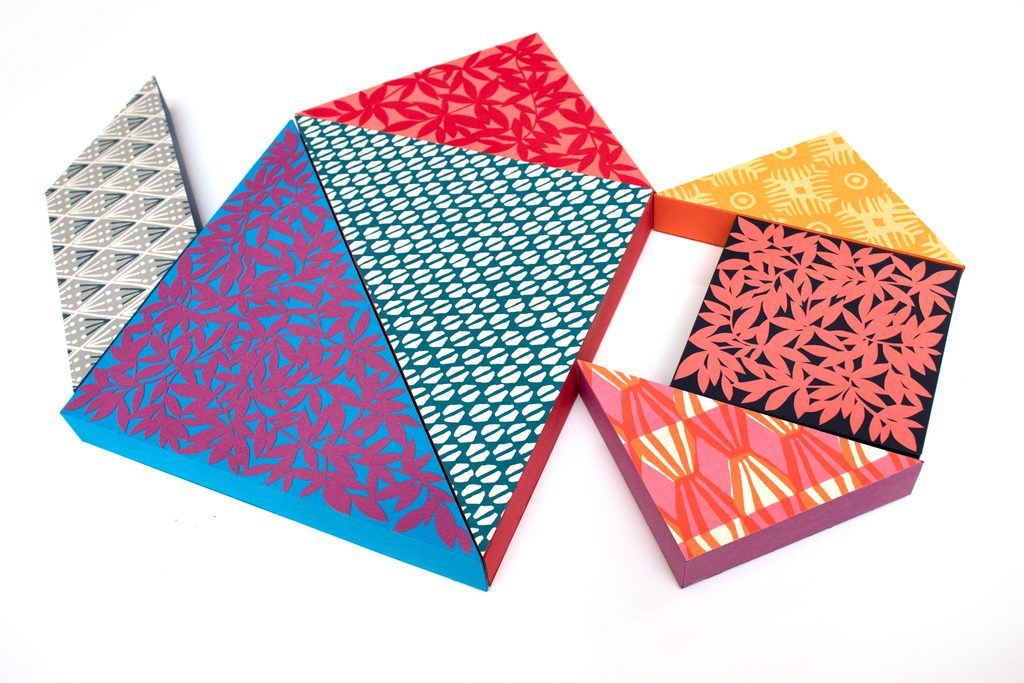
An open call for tactile art inspired me to create a version of my paper modules for viewers to touch and gently play with. The work is based on The Tangram, a dissection puzzle made up of seven polygons – two large triangles, two small triangles, one medium triangle, one square, and one parallelogram. The default configuration of the puzzle pieces has them arranged into a square. The puzzle is meant to be taken apart and rearranged into an infinite variety of configurations.
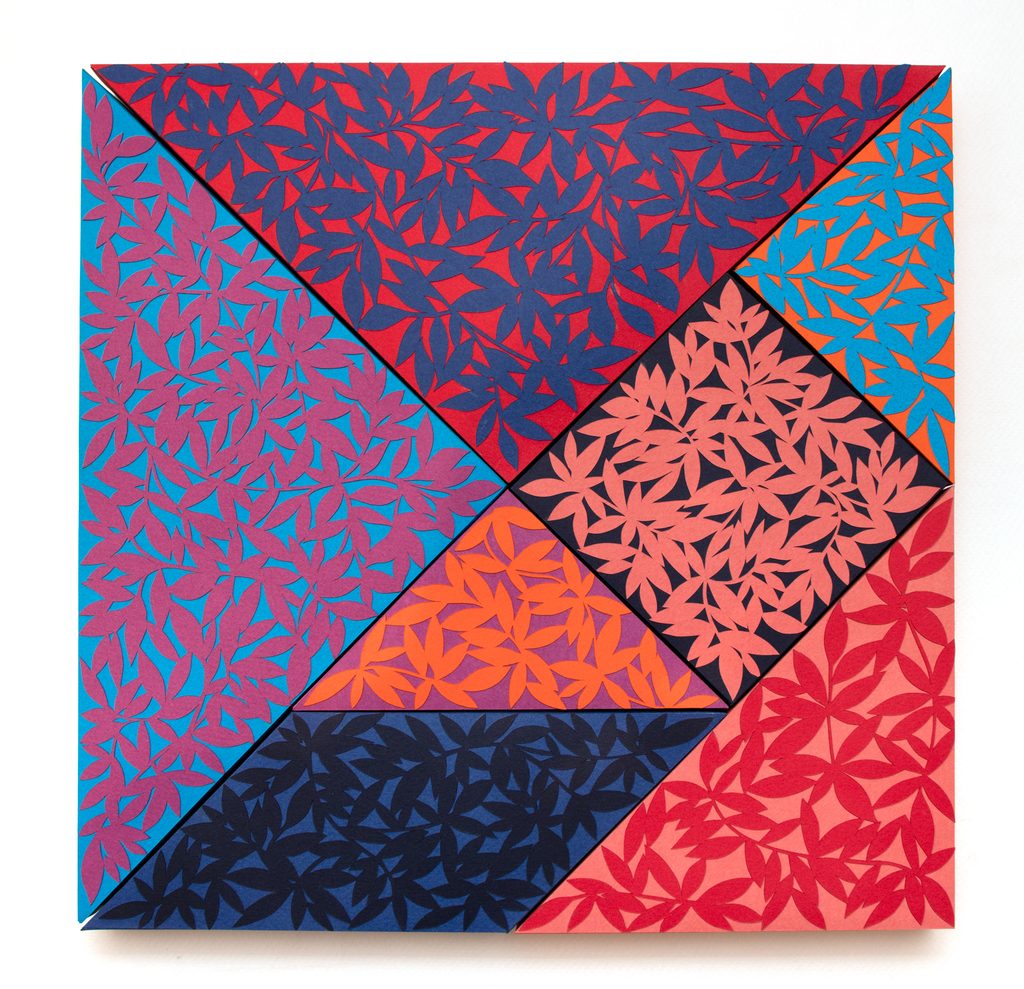
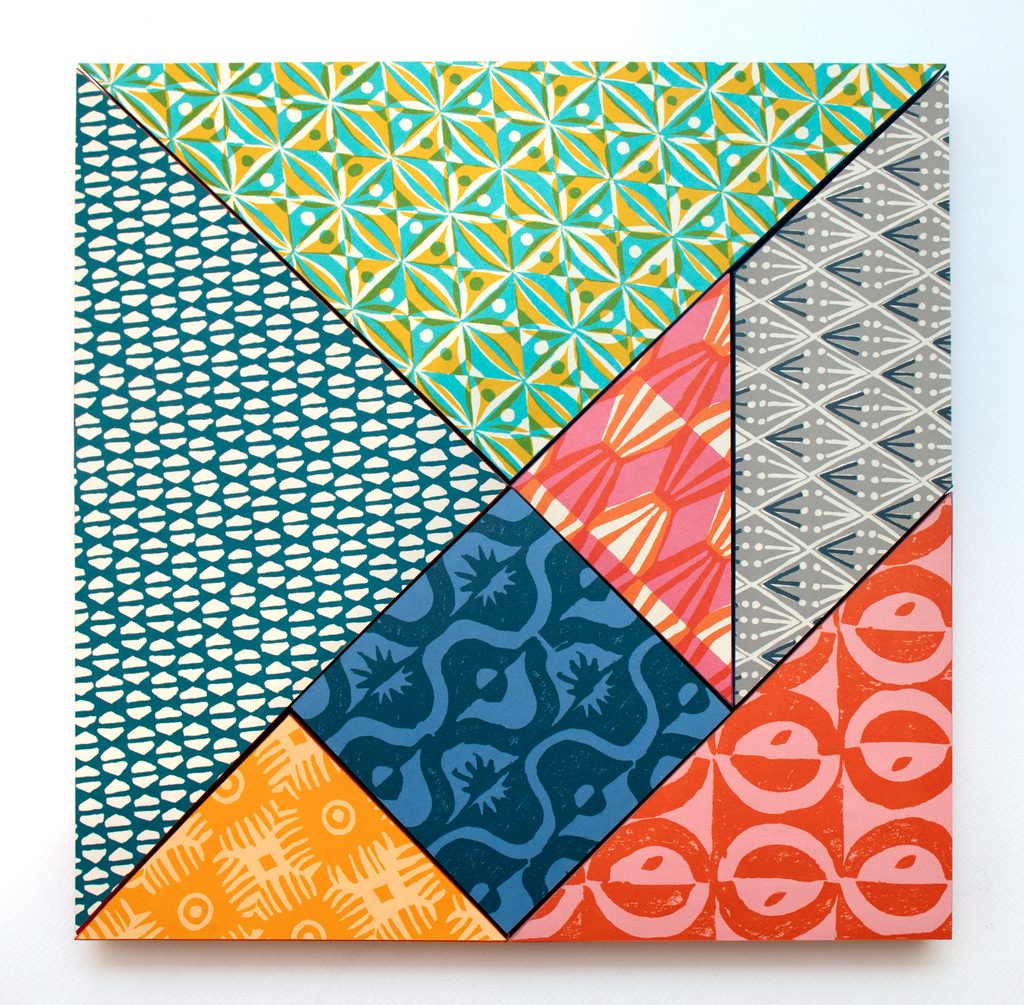
I had a small plastic version of a Tangram puzzle when I was a kid, and I enjoyed playing with it. I’ve created my Tangram puzzle on a much larger scale using a variety of papers. The basic configuration as a square is 12 3/16” x 12 3/16” x 1”. All seven pieces are double-sided with colourful decorative papers on one side, and hand-cut leafy vine designs on the other. They are meant to give people the experience of playing with shapes, and the different designs, to be flipped around to play with mixing the patterned surfaces as well as the shapes.
From Wikipedia: The tangram (Chinese: 七巧板; pinyin: qīqiǎobǎn; lit. ‘seven boards of skill’) is a dissection puzzle consisting of seven flat polygons, called tans, which are put together to form shapes. The objective is to replicate a pattern (given only an outline) generally found in a puzzle book using all seven pieces without overlap. Alternatively the tans can be used to create original minimalist designs that are either appreciated for their inherent aesthetic merits or as the basis for challenging others to replicate its outline. It is reputed to have been invented in China sometime around the late 18th century and then carried over to America and Europe by trading ships shortly after.[1] It became very popular in Europe for a time, and then again during World War I. It is one of the most widely recognized dissection puzzles in the world and has been used for various purposes including amusement, art, and education.
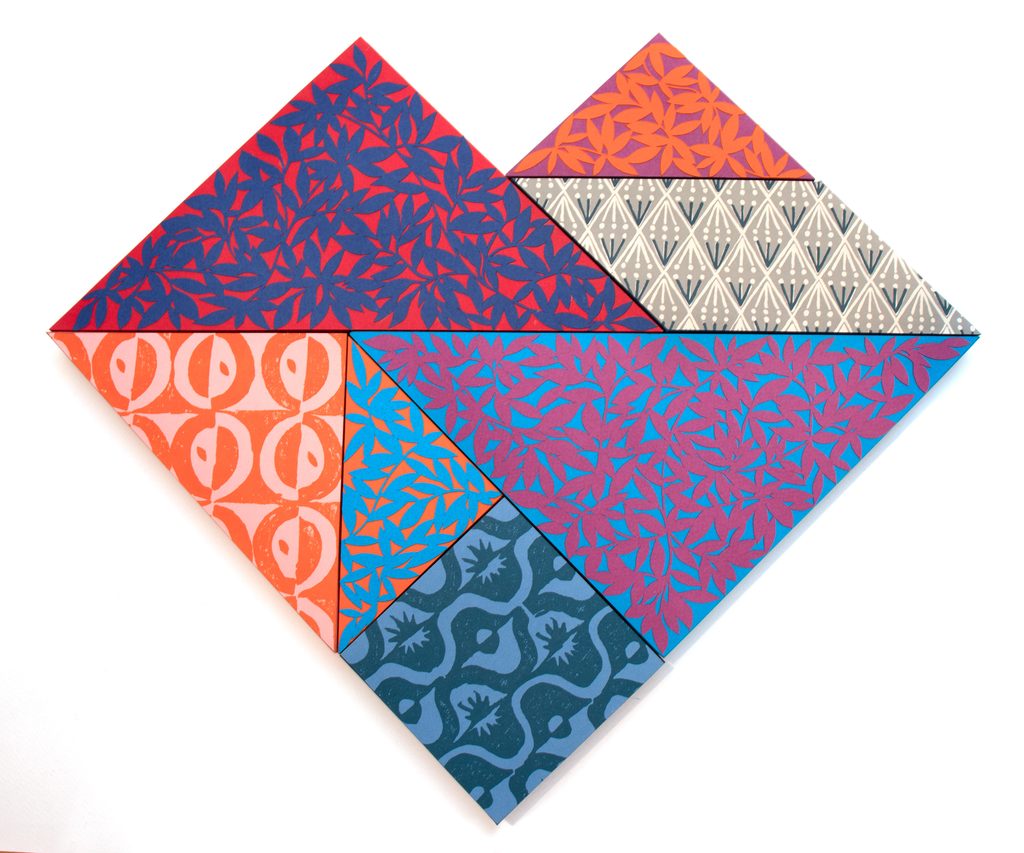
Unfortunately the work did not get accepted into the exhibition I’d intended it for. I got a lot of enjoyment out of making this and will have it available for people to play with during Culture Crawl in November.